
Choosing between a water filling machine and a juice or tea filling machine is not simply a question of bottle size or production speed. The liquid itself changes the hygiene strategy, filling temperature, valve design, cleaning system, bottle requirements, and equipment installed before and after the filler.
In practical terms, a water filling line is normally designed for a low-viscosity product that is filled cold under controlled hygienic conditions. Juice and tea are more sensitive beverages. Depending on the recipe and required shelf life, they may need hot filling, ultra-clean filling, or aseptic filling, together with pasteurization and stricter control of product contact surfaces.
This comparison explains the engineering differences and helps beverage producers decide which configuration fits their product.
Quick Comparison: Water Filling Machine vs Juice Filling Machine
| Comparison point | Water filling machine | Juice/tea filling machine |
|---|---|---|
| Typical product | Purified water, mineral water, still water | Juice, nectar, tea, functional drinks, still beverages |
| Common filling condition | Ambient or cold filling | Hot fill, ultra-clean, or aseptic fill |
| Product treatment | Water treatment and disinfection | Blending, filtration, deaeration, homogenization when required, and pasteurization/UHT |
| Product viscosity | Usually very low | Low to moderate; may contain pulp, fibers, or particles |
| Main microbiological concern | Preventing contamination after water treatment | Controlling microorganisms while protecting taste, color, and nutrients |
| Filler design | Relatively straightforward hygienic design | Higher hygiene level, temperature control, product circulation, or sterile zone |
| Cleaning | Routine CIP and sanitation | More demanding CIP; aseptic systems also require sterilization procedures |
| Bottle requirement | Standard PET bottles are common | Heat-resistant PET or glass for hot fill; sterilized packaging for aseptic fill |
| Downstream equipment | Capping, labeling, packing | Capping plus bottle inversion and cooling tunnel for many hot-fill lines |
| Investment and operation | Generally simpler | Generally more complex because the line must manage product safety and thermal conditions |
The exact configuration still depends on pH, ingredients, particles, filling temperature, bottle material, distribution method, and target shelf life.
What Is a Water Filling Machine?

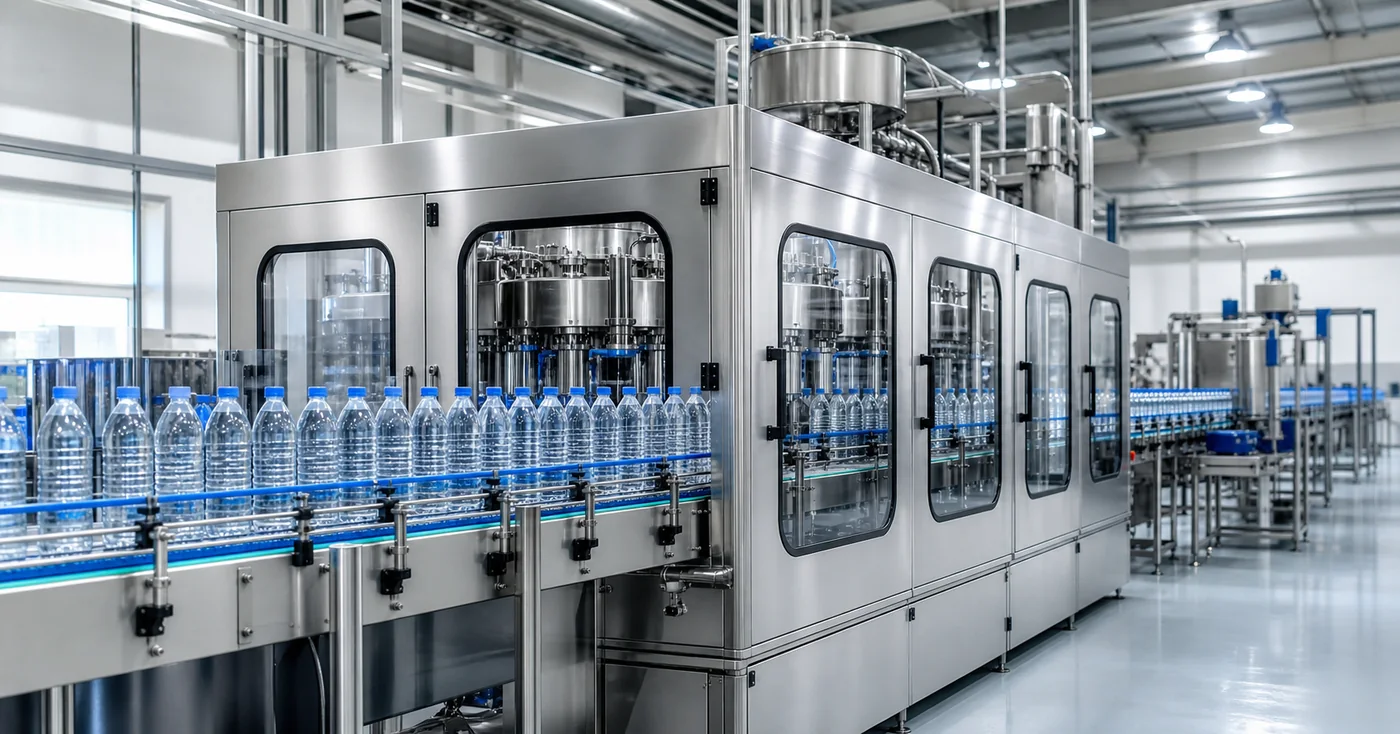
A water filling machine transfers treated drinking water into bottles and closes them while minimizing recontamination. A common PET-bottle system combines rinsing, filling, and capping in one monoblock. Empty bottles enter the rinser, move to the filling carousel, and are capped before leaving the enclosed area.
Because water has low viscosity and contains no pulp, its flow behavior is predictable. Gravity filling is widely used for still water, while pressurized or other specialized filling methods may be selected for sparkling water. The upstream system normally includes raw-water treatment, filtration, reverse osmosis where required, UV or ozone treatment, and hygienic storage.
The engineering priority is to maintain the quality already achieved by the water treatment system. This requires hygienic tanks and piping, controlled bottle rinsing, clean filling conditions, reliable cap handling, and an effective sanitation program.
What Is a Juice or Tea Filling Machine?

A fruit juice or tea drink filling machine handles a beverage whose composition can support spoilage and whose flavor, color, and nutritional quality may change during processing. The filler therefore operates as part of a broader product-treatment and packaging system.
The line may receive a blended beverage from sugar-dissolving, extraction, filtration, mixing, homogenization, and deaeration equipment. The product is then pasteurized or sterilized according to its recipe and packaging method. After treatment, it must reach the filler without being recontaminated.
Three configurations are common:
Hot filling
Pasteurized juice or tea is filled while hot. The hot product helps control microorganisms on product-contact areas of the package. Tetra Pak describes hot filling of juice at temperatures above 84°C, while noting that the actual temperature and holding conditions depend on the product and package. The bottle is capped, often tilted or inverted to expose the closure area to the hot product, held for the required time, and then cooled.
Ultra-clean or high-hygiene filling
Ultra-clean filling provides more contamination control than a conventional cold-fill line but does not create the fully sterile conditions of an aseptic system. It may be appropriate for certain acidic beverages, preservative-supported recipes, or products distributed under defined conditions. The required hygiene level must be validated for the beverage and shelf-life target.
Aseptic filling
The product and package are sterilized separately and brought together in a controlled sterile environment. Pasteurized or UHT-treated juice or tea can be cooled before filling, reducing the time the beverage spends at elevated temperature. Aseptic filling is technically more complex, but it can support ambient distribution and sensitive product formulations when the complete process is correctly designed and validated.
Seven Important Differences Between the Two Machines

1. Microbiological risk and hygiene level
Treated water must be protected from recontamination, but juice and tea generally present a more demanding microbiological challenge because they contain nutrients and other ingredients. Product acidity helps determine which organisms must be controlled, but acidity alone does not define a safe process.
For this reason, a juice or tea line may require a hot-fill circuit, an ultra-clean enclosure, or an aseptic zone. Hygienic valves, sterile barriers, filtered air, controlled pressure, and package decontamination may be part of the design. A standard water filler should not be assumed to provide these controls.
2. Filling temperature and thermal management
Still water is commonly filled near ambient temperature or cold. Its filler does not normally need to keep the product at pasteurization-related temperatures.
A hot-fill beverage line must maintain a validated temperature through the filler and prevent cold spots or excessive product residence time. The system may use an insulated product bowl, recirculation loop, temperature sensors, automatic diversion, and hot-return channels. Krones, for example, describes a juice filler with a recirculation channel for retaining product heat and a closed CIP arrangement.
Thermal management continues after capping. Hot-filled bottles normally require controlled cooling to protect product quality and bottle stability.
3. Filling valve and product path
Water can pass through relatively simple filling valves because it is thin and free of suspended solids. Juice and tea recipes vary much more. Some are clear and low-viscosity, while others contain pulp, fibers, sacs, or small particles.
The valve opening, flow path, seals, and metering method must match the product. Narrow passages can trap fibers or cause blockages. Aggressive flow can damage pulp or create foam. A suitable juice filling machine may therefore use larger passages, pulp-compatible valves, flow meters, or a two-stage filling arrangement.
Before equipment selection, the supplier should receive the product viscosity, pulp or particle size, solids content, tendency to foam, and filling temperature—not only the bottle volume and target output.
4. Cleaning-in-place and sterilization
Both machine types need hygienic cleaning, but juice and tea leave sugars, flavors, extracts, pulp, and other residues on product-contact surfaces. These deposits can be harder to remove than water residue and can support microbial growth if cleaning is incomplete.
A beverage line should be designed for effective cleaning-in-place (CIP), with controlled chemical concentration, temperature, flow, and time. Dead legs, difficult valve cavities, and poorly drained pipes increase cleaning risk. Hot-fill and aseptic systems may also need intermediate cleaning, hot-water disinfection, steam sterilization, or sterilization-in-place procedures.
The buyer should ask how the filler connects to the plant CIP station, whether cleaning cups are automatic, how return flow is verified, and which components require manual intervention.
5. Bottle and closure requirements
Standard lightweight PET bottles used for water may deform during hot filling. A hot-fill line normally requires heat-resistant PET bottles, suitable base and panel designs, or glass containers. Sidel notes that hot-fill PET production uses heat-resistant stretch blow molding and heated molds to produce bottles that withstand the filling conditions.
Aseptic filling can use lighter bottle concepts because the finished bottle does not have to tolerate the same hot-fill temperature, but the package or preform and closure must be decontaminated. Bottle design, resin use, cap treatment, oxygen barrier needs, and shelf appearance should therefore be evaluated together with the filling method.
6. Upstream and downstream line equipment
A water filler usually connects to a water treatment system and hygienic finished-water tank. A juice or tea filler may require a complete process room containing ingredient handling, syrup preparation, blending, filtration, deaeration, homogenization, pasteurization, and buffer equipment.
The downstream difference is equally important. A typical hot-fill line may add:
- A cap and bottle inversion or tilting section
- A holding section when required by the validated process
- A multi-zone cooling tunnel
- Bottle drying before labeling
- Inspection and rejection controls
An aseptic line instead concentrates more complexity around sterilization, sterile transfer, environmental control, and aseptic filling and capping.
7. Changeover and production flexibility
A water line often changes between bottle sizes while running essentially the same product. A juice or tea factory may change recipes, acidity, pulp content, filling temperature, bottle format, and cleaning program. Each variable can affect production scheduling and changeover time.
A machine advertised for both water and juice is not automatically suitable for every recipe. Flexibility must be confirmed at system level: process equipment, filler hygiene class, valves, thermal control, bottle production, cooling capacity, and cleaning validation all need to support the planned product range.
Can One Filling Machine Handle Water, Juice, and Tea?
It is technically possible to design a flexible line for several beverages, but it is rarely as simple as using one basic water filler for every product.
A shared line is more realistic when the beverages have compatible processing and hygiene requirements. For example, clear, non-carbonated beverages in similar bottles may be handled by a purpose-designed high-hygiene or aseptic platform. Even then, recipes, changeover procedures, allergen controls, product recovery, CIP cycles, and validation must be considered.
Retrofitting a conventional water filling machine for hot juice can require changes to the product tank, valves, seals, piping, recirculation system, controls, enclosure, cap treatment, bottle specification, and downstream cooling. In many projects, selecting the correct beverage process from the beginning is safer and more economical than converting an unsuitable machine later.
How to Choose the Right Filling System
Prepare a product and packaging specification before requesting a quotation. At minimum, give the equipment supplier the following information:
- Beverage type and complete product category
- pH, Brix, viscosity, and ingredients
- Pulp, fiber, or particle size and concentration
- Required shelf life and storage temperature
- Preservative strategy, if applicable
- Planned filling method and filling temperature
- Bottle material, neck finish, volume, and closure
- Required output in bottles per hour
- Number of products and daily changeover frequency
- Available utilities, factory space, and automation target
The final process should be defined with qualified beverage technologists and validated against the actual recipe, package, and distribution conditions. The filler is only one control point within that process.
Cost Considerations Beyond the Machine Price
A water filling machine generally has a lower technical barrier because it does not need the thermal and sterile controls associated with sensitive beverages. Juice and tea projects can require higher initial investment in processing, pasteurization, hygienic design, cooling, and automation.
Purchase price, however, is only one part of the decision. Compare:
- Energy used for heating, cooling, and sterilization
- Water and chemical consumption during CIP
- Product loss during start-up, changeover, and cleaning
- Bottle weight and heat-resistant packaging cost
- Line availability and changeover time
- Operator skill and maintenance requirements
- Shelf-life performance and distribution conditions
- Future recipes and package formats
A lower-cost machine that cannot maintain the validated process may create far greater losses through rejected product, short shelf life, or production downtime.
Frequently Asked Questions
Is a juice filling machine the same as a water filling machine?
No. Although both machines transfer liquid into containers, a juice filling machine normally needs a higher hygiene level, product-compatible valves, more rigorous cleaning, and either hot-fill, ultra-clean, or aseptic process controls.
Can juice be filled cold?
Yes, but “cold filling” can refer to different hygiene concepts. Chilled distribution, preservative-supported filling, ultra-clean filling, and aseptic filling have different requirements. The correct method depends on the recipe, pH, package, shelf life, and distribution conditions.
Why are juice and tea often hot filled?
Hot filling uses the temperature of the pasteurized beverage as part of the microbial-control process for the container and closure. It is a proven option for many acidic juices, teas, and still drinks, but the heat load and packaging requirements must be managed carefully.
Does hot filling require a special PET bottle?
Usually, yes. Conventional lightweight water bottles may deform at hot-fill temperatures. Heat-resistant PET bottles use suitable resin distribution and bottle geometry to withstand filling, holding, and cooling conditions.
Can a filling machine handle juice with pulp?
Only if the product path and filling valve are designed for the specified pulp, fiber, or particle size. The supplier must evaluate the actual product rather than assuming that every juice behaves like a clear liquid.
Which information is needed to select a beverage filling machine?
The most important inputs are the recipe, pH, Brix, viscosity, particles, filling temperature, bottle and cap, required shelf life, storage conditions, output, and cleaning requirements.
Conclusion
The key difference in the water filling machine vs juice filling machine decision is the level of product protection required. Water filling focuses on preserving treated-water quality during rinsing, filling, and capping. Juice and tea filling must also manage ingredients, microorganisms, heat exposure, product residue, packaging resistance, and shelf-life targets.
For a reliable equipment proposal, provide your beverage recipe range, bottle samples, required capacity, filling temperature, and shelf-life target. ThanK-Pack can then evaluate whether a cold-fill, hot-fill, ultra-clean, or aseptic configuration is appropriate and prepare a line layout around the actual production conditions. Contact ThanK-Pack to discuss your beverage and packaging requirements.Choosing between a water filling machine and a juice or tea filling machine is not simply a question of bottle size or production speed. The liquid itself changes the hygiene strategy, filling temperature, valve design, cleaning system, bottle requirements, and equipment installed before and after the filler.
In practical terms, a water filling line is normally designed for a low-viscosity product that is filled cold under controlled hygienic conditions. Juice and tea are more sensitive beverages. Depending on the recipe and required shelf life, they may need hot filling, ultra-clean filling, or aseptic filling, together with pasteurization and stricter control of product contact surfaces.
This comparison explains the engineering differences and helps beverage producers decide which configuration fits their product.
Quick Comparison: Water Filling Machine vs Juice Filling Machine
| Comparison point | Water filling machine | Juice/tea filling machine |
|---|---|---|
| Typical product | Purified water, mineral water, still water | Juice, nectar, tea, functional drinks, still beverages |
| Common filling condition | Ambient or cold filling | Hot fill, ultra-clean, or aseptic fill |
| Product treatment | Water treatment and disinfection | Blending, filtration, deaeration, homogenization when required, and pasteurization/UHT |
| Product viscosity | Usually very low | Low to moderate; may contain pulp, fibers, or particles |
| Main microbiological concern | Preventing contamination after water treatment | Controlling microorganisms while protecting taste, color, and nutrients |
| Filler design | Relatively straightforward hygienic design | Higher hygiene level, temperature control, product circulation, or sterile zone |
| Cleaning | Routine CIP and sanitation | More demanding CIP; aseptic systems also require sterilization procedures |
| Bottle requirement | Standard PET bottles are common | Heat-resistant PET or glass for hot fill; sterilized packaging for aseptic fill |
| Downstream equipment | Capping, labeling, packing | Capping plus bottle inversion and cooling tunnel for many hot-fill lines |
| Investment and operation | Generally simpler | Generally more complex because the line must manage product safety and thermal conditions |
The exact configuration still depends on pH, ingredients, particles, filling temperature, bottle material, distribution method, and target shelf life.
What Is a Water Filling Machine?
A water filling machine transfers treated drinking water into bottles and closes them while minimizing recontamination. A common PET-bottle system combines rinsing, filling, and capping in one monoblock. Empty bottles enter the rinser, move to the filling carousel, and are capped before leaving the enclosed area.
Because water has low viscosity and contains no pulp, its flow behavior is predictable. Gravity filling is widely used for still water, while pressurized or other specialized filling methods may be selected for sparkling water. The upstream system normally includes raw-water treatment, filtration, reverse osmosis where required, UV or ozone treatment, and hygienic storage.
The engineering priority is to maintain the quality already achieved by the water treatment system. This requires hygienic tanks and piping, controlled bottle rinsing, clean filling conditions, reliable cap handling, and an effective sanitation program.
What Is a Juice or Tea Filling Machine?
A fruit juice or tea drink filling machine handles a beverage whose composition can support spoilage and whose flavor, color, and nutritional quality may change during processing. The filler therefore operates as part of a broader product-treatment and packaging system.
The line may receive a blended beverage from sugar-dissolving, extraction, filtration, mixing, homogenization, and deaeration equipment. The product is then pasteurized or sterilized according to its recipe and packaging method. After treatment, it must reach the filler without being recontaminated.
Three configurations are common:
Hot filling
Pasteurized juice or tea is filled while hot. The hot product helps control microorganisms on product-contact areas of the package. Tetra Pak describes hot filling of juice at temperatures above 84°C, while noting that the actual temperature and holding conditions depend on the product and package. The bottle is capped, often tilted or inverted to expose the closure area to the hot product, held for the required time, and then cooled.
Ultra-clean or high-hygiene filling
Ultra-clean filling provides more contamination control than a conventional cold-fill line but does not create the fully sterile conditions of an aseptic system. It may be appropriate for certain acidic beverages, preservative-supported recipes, or products distributed under defined conditions. The required hygiene level must be validated for the beverage and shelf-life target.
Aseptic filling
The product and package are sterilized separately and brought together in a controlled sterile environment. Pasteurized or UHT-treated juice or tea can be cooled before filling, reducing the time the beverage spends at elevated temperature. Aseptic filling is technically more complex, but it can support ambient distribution and sensitive product formulations when the complete process is correctly designed and validated.
Seven Important Differences Between the Two Machines
1. Microbiological risk and hygiene level
Treated water must be protected from recontamination, but juice and tea generally present a more demanding microbiological challenge because they contain nutrients and other ingredients. Product acidity helps determine which organisms must be controlled, but acidity alone does not define a safe process.
For this reason, a juice or tea line may require a hot-fill circuit, an ultra-clean enclosure, or an aseptic zone. Hygienic valves, sterile barriers, filtered air, controlled pressure, and package decontamination may be part of the design. A standard water filler should not be assumed to provide these controls.
2. Filling temperature and thermal management
Still water is commonly filled near ambient temperature or cold. Its filler does not normally need to keep the product at pasteurization-related temperatures.
A hot-fill beverage line must maintain a validated temperature through the filler and prevent cold spots or excessive product residence time. The system may use an insulated product bowl, recirculation loop, temperature sensors, automatic diversion, and hot-return channels. Krones, for example, describes a juice filler with a recirculation channel for retaining product heat and a closed CIP arrangement.
Thermal management continues after capping. Hot-filled bottles normally require controlled cooling to protect product quality and bottle stability.
3. Filling valve and product path
Water can pass through relatively simple filling valves because it is thin and free of suspended solids. Juice and tea recipes vary much more. Some are clear and low-viscosity, while others contain pulp, fibers, sacs, or small particles.
The valve opening, flow path, seals, and metering method must match the product. Narrow passages can trap fibers or cause blockages. Aggressive flow can damage pulp or create foam. A suitable juice filling machine may therefore use larger passages, pulp-compatible valves, flow meters, or a two-stage filling arrangement.
Before equipment selection, the supplier should receive the product viscosity, pulp or particle size, solids content, tendency to foam, and filling temperature—not only the bottle volume and target output.
4. Cleaning-in-place and sterilization
Both machine types need hygienic cleaning, but juice and tea leave sugars, flavors, extracts, pulp, and other residues on product-contact surfaces. These deposits can be harder to remove than water residue and can support microbial growth if cleaning is incomplete.
A beverage line should be designed for effective cleaning-in-place (CIP), with controlled chemical concentration, temperature, flow, and time. Dead legs, difficult valve cavities, and poorly drained pipes increase cleaning risk. Hot-fill and aseptic systems may also need intermediate cleaning, hot-water disinfection, steam sterilization, or sterilization-in-place procedures.
The buyer should ask how the filler connects to the plant CIP station, whether cleaning cups are automatic, how return flow is verified, and which components require manual intervention.
5. Bottle and closure requirements
Standard lightweight PET bottles used for water may deform during hot filling. A hot-fill line normally requires heat-resistant PET bottles, suitable base and panel designs, or glass containers. Sidel notes that hot-fill PET production uses heat-resistant stretch blow molding and heated molds to produce bottles that withstand the filling conditions.
Aseptic filling can use lighter bottle concepts because the finished bottle does not have to tolerate the same hot-fill temperature, but the package or preform and closure must be decontaminated. Bottle design, resin use, cap treatment, oxygen barrier needs, and shelf appearance should therefore be evaluated together with the filling method.
6. Upstream and downstream line equipment
A water filler usually connects to a water treatment system and hygienic finished-water tank. A juice or tea filler may require a complete process room containing ingredient handling, syrup preparation, blending, filtration, deaeration, homogenization, pasteurization, and buffer equipment.
The downstream difference is equally important. A typical hot-fill line may add:
- A cap and bottle inversion or tilting section
- A holding section when required by the validated process
- A multi-zone cooling tunnel
- Bottle drying before labeling
- Inspection and rejection controls
An aseptic line instead concentrates more complexity around sterilization, sterile transfer, environmental control, and aseptic filling and capping.
7. Changeover and production flexibility
A water line often changes between bottle sizes while running essentially the same product. A juice or tea factory may change recipes, acidity, pulp content, filling temperature, bottle format, and cleaning program. Each variable can affect production scheduling and changeover time.
A machine advertised for both water and juice is not automatically suitable for every recipe. Flexibility must be confirmed at system level: process equipment, filler hygiene class, valves, thermal control, bottle production, cooling capacity, and cleaning validation all need to support the planned product range.
Can One Filling Machine Handle Water, Juice, and Tea?
It is technically possible to design a flexible line for several beverages, but it is rarely as simple as using one basic water filler for every product.
A shared line is more realistic when the beverages have compatible processing and hygiene requirements. For example, clear, non-carbonated beverages in similar bottles may be handled by a purpose-designed high-hygiene or aseptic platform. Even then, recipes, changeover procedures, allergen controls, product recovery, CIP cycles, and validation must be considered.
Retrofitting a conventional water filling machine for hot juice can require changes to the product tank, valves, seals, piping, recirculation system, controls, enclosure, cap treatment, bottle specification, and downstream cooling. In many projects, selecting the correct beverage process from the beginning is safer and more economical than converting an unsuitable machine later.
How to Choose the Right Filling System
Prepare a product and packaging specification before requesting a quotation. At minimum, give the equipment supplier the following information:
- Beverage type and complete product category
- pH, Brix, viscosity, and ingredients
- Pulp, fiber, or particle size and concentration
- Required shelf life and storage temperature
- Preservative strategy, if applicable
- Planned filling method and filling temperature
- Bottle material, neck finish, volume, and closure
- Required output in bottles per hour
- Number of products and daily changeover frequency
- Available utilities, factory space, and automation target
The final process should be defined with qualified beverage technologists and validated against the actual recipe, package, and distribution conditions. The filler is only one control point within that process.
Cost Considerations Beyond the Machine Price
A water filling machine generally has a lower technical barrier because it does not need the thermal and sterile controls associated with sensitive beverages. Juice and tea projects can require higher initial investment in processing, pasteurization, hygienic design, cooling, and automation.
Purchase price, however, is only one part of the decision. Compare:
- Energy used for heating, cooling, and sterilization
- Water and chemical consumption during CIP
- Product loss during start-up, changeover, and cleaning
- Bottle weight and heat-resistant packaging cost
- Line availability and changeover time
- Operator skill and maintenance requirements
- Shelf-life performance and distribution conditions
- Future recipes and package formats
A lower-cost machine that cannot maintain the validated process may create far greater losses through rejected product, short shelf life, or production downtime.
Frequently Asked Questions
Is a juice filling machine the same as a water filling machine?
No. Although both machines transfer liquid into containers, a juice filling machine normally needs a higher hygiene level, product-compatible valves, more rigorous cleaning, and either hot-fill, ultra-clean, or aseptic process controls.
Can juice be filled cold?
Yes, but “cold filling” can refer to different hygiene concepts. Chilled distribution, preservative-supported filling, ultra-clean filling, and aseptic filling have different requirements. The correct method depends on the recipe, pH, package, shelf life, and distribution conditions.
Why are juice and tea often hot filled?
Hot filling uses the temperature of the pasteurized beverage as part of the microbial-control process for the container and closure. It is a proven option for many acidic juices, teas, and still drinks, but the heat load and packaging requirements must be managed carefully.
Does hot filling require a special PET bottle?
Usually, yes. Conventional lightweight water bottles may deform at hot-fill temperatures. Heat-resistant PET bottles use suitable resin distribution and bottle geometry to withstand filling, holding, and cooling conditions.
Can a filling machine handle juice with pulp?
Only if the product path and filling valve are designed for the specified pulp, fiber, or particle size. The supplier must evaluate the actual product rather than assuming that every juice behaves like a clear liquid.
Which information is needed to select a beverage filling machine?
The most important inputs are the recipe, pH, Brix, viscosity, particles, filling temperature, bottle and cap, required shelf life, storage conditions, output, and cleaning requirements.
Conclusion
The key difference in the water filling machine vs juice filling machine decision is the level of product protection required. Water filling focuses on preserving treated-water quality during rinsing, filling, and capping. Juice and tea filling must also manage ingredients, microorganisms, heat exposure, product residue, packaging resistance, and shelf-life targets.
For a reliable equipment proposal, provide your beverage recipe range, bottle samples, required capacity, filling temperature, and shelf-life target. ThanK-Pack can then evaluate whether a cold-fill, hot-fill, ultra-clean, or aseptic configuration is appropriate and prepare a line layout around the actual production conditions. Contact ThanK-Pack to discuss your beverage and packaging requirements.