
Choosing the right bottled water filling machine is not simply a matter of buying the model with the highest rated speed. The correct machine must match your bottle sizes, realistic hourly demand, working hours, utility conditions, automation plan, hygiene requirements, and expected business growth.
A machine that is too small can quickly become a production bottleneck. A machine that is too large may increase investment, energy use, factory space, and maintenance costs before sales justify them. This guide explains how to convert your production target into a practical equipment specification and how to compare water bottling machine options with less risk.
Start With Saleable Output, Not Rated Speed
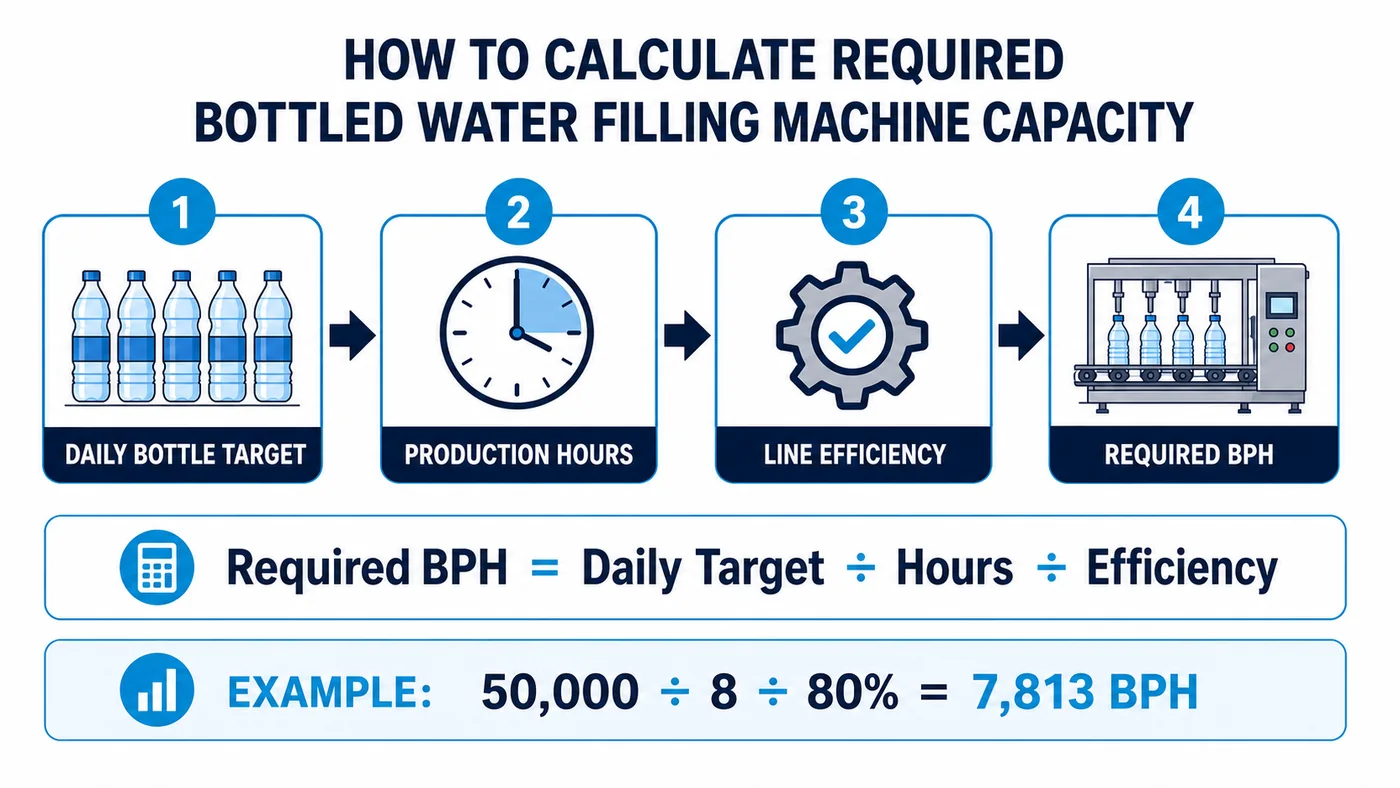
Production capacity is normally shown in bottles per hour (BPH), but rated speed is not the same as the number of saleable bottles you can ship. Cleaning, product changeovers, cap replenishment, label replacement, operator breaks, inspections, and minor stops all reduce real output.
Use this basic calculation:
Required rated capacity = Daily sales target ÷ Available production hours ÷ Expected line efficiency
For example, a plant that needs 50,000 bottles per day, runs for eight hours, and expects 80% line efficiency requires about 7,813 BPH. In this case, a 6,000 BPH machine would leave too little margin, while a model in the 8,000–10,000 BPH range is more practical.
Calculate from confirmed demand, reasonable market growth, and your real production schedule. Avoid sizing the line only from an optimistic sales forecast.
Confirm Capacity for Every Bottle Size
A quoted capacity is usually based on one reference bottle, often 500 ml. Larger bottles take longer to fill, so the same machine may produce fewer 1.5 L or 2 L bottles per hour. Bottle height, diameter, neck finish, cap type, and water flow characteristics also affect performance.
Before requesting a quotation, prepare a bottle specification sheet that includes:
- All bottle volumes planned for production
- Bottle material, dimensions, weight, and neck finish
- Cap type, diameter, and closure requirements
- Target BPH for each bottle format
- Expected percentage of production for each SKU
- Maximum acceptable changeover time
If several formats will run on the same water filling line, ask the supplier to confirm the change parts, adjustment procedure, and output for every format—not only the smallest bottle.
Match the Machine Model to the Required Capacity
Thank Pack’s CGF series combines rinsing, filling, and capping in one automatic monoblock for 200 ml to 2 L PET bottles. The following specifications provide a useful starting point when matching capacity to a machine model.
| Model | Rinsing/Filling/Capping Heads | Capacity (BPH) | Power | Overall Size (mm) |
|---|---|---|---|---|
| CGF8-8-3 | 8/8/3 | 2,000–2,500 | 2.5 kW | 1950×1450×2350 |
| CGF16-16-5 | 16/16/5 | 3,000–4,000 | 3.1 kW | 2400×1600×2400 |
| CGF18-18-6 | 18/18/6 | 6,000–8,000 | 3.1 kW | 2400×1830×2400 |
| CGF24-24-8 | 24/24/8 | 10,000–12,000 | 3.8 kW | 3100×2200×2400 |
| CGF32-32-10 | 32/32/10 | 12,000–14,000 | 5.6 kW | 3600×2500×2400 |
| CGF40-40-12 | 40/40/12 | 16,000–18,000 | 7.2 kW | 4000×2800×2400 |
| CGF50-50-15 | 50/50/15 | 22,000–24,000 | 9.6 kW | 5450×3210×2400 |
These figures should be verified against the final bottle, cap, water characteristics, and line layout. For model-specific configuration, review the bottled water filling machine product page or discuss samples with the engineering team.
Balance the Complete PET Bottle Filling Line
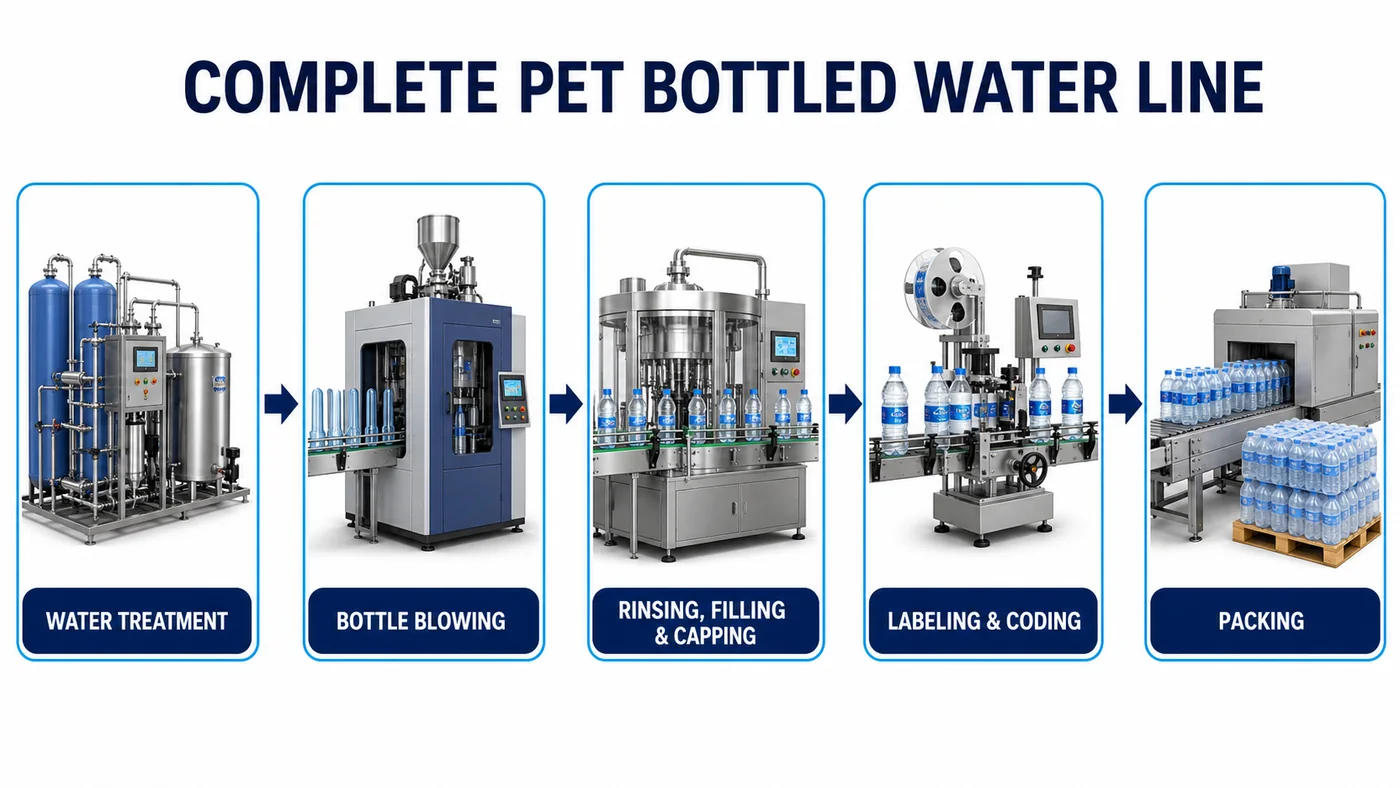
The filler cannot maintain its rated speed if upstream or downstream equipment is slower. A complete PET bottle filling line may include water treatment, bottle blowing, air conveying, rinsing-filling-capping, labeling, coding, packing, and pallet handling.
Each section should have enough capacity and a controlled buffer. The bottle blowing machine must supply bottles consistently. The labeling machine and packing machine must handle the filler’s real discharge rate. Conveyors should absorb short interruptions without causing repeated stops.
Ask for a line-level capacity commitment, not only the maximum speed of the filling monoblock. The slowest machine defines the practical output of the entire line.
Choose the Correct Automation Level
Automation should reflect labor cost, quality requirements, production scale, technical resources, and the number of shifts. A small project may start with simpler bottle handling and secondary packaging, while a high-output factory usually benefits from automatic cap feeding, label control, pack formation, palletizing, and centralized line monitoring.
Higher automation can reduce manual contact and improve consistency, but it also requires trained operators, reliable spare parts, and disciplined maintenance. Compare the total operating cost rather than assuming the most automated solution is automatically the best investment.
Evaluate the 3-in-1 Rinsing, Filling, and Capping Monoblock
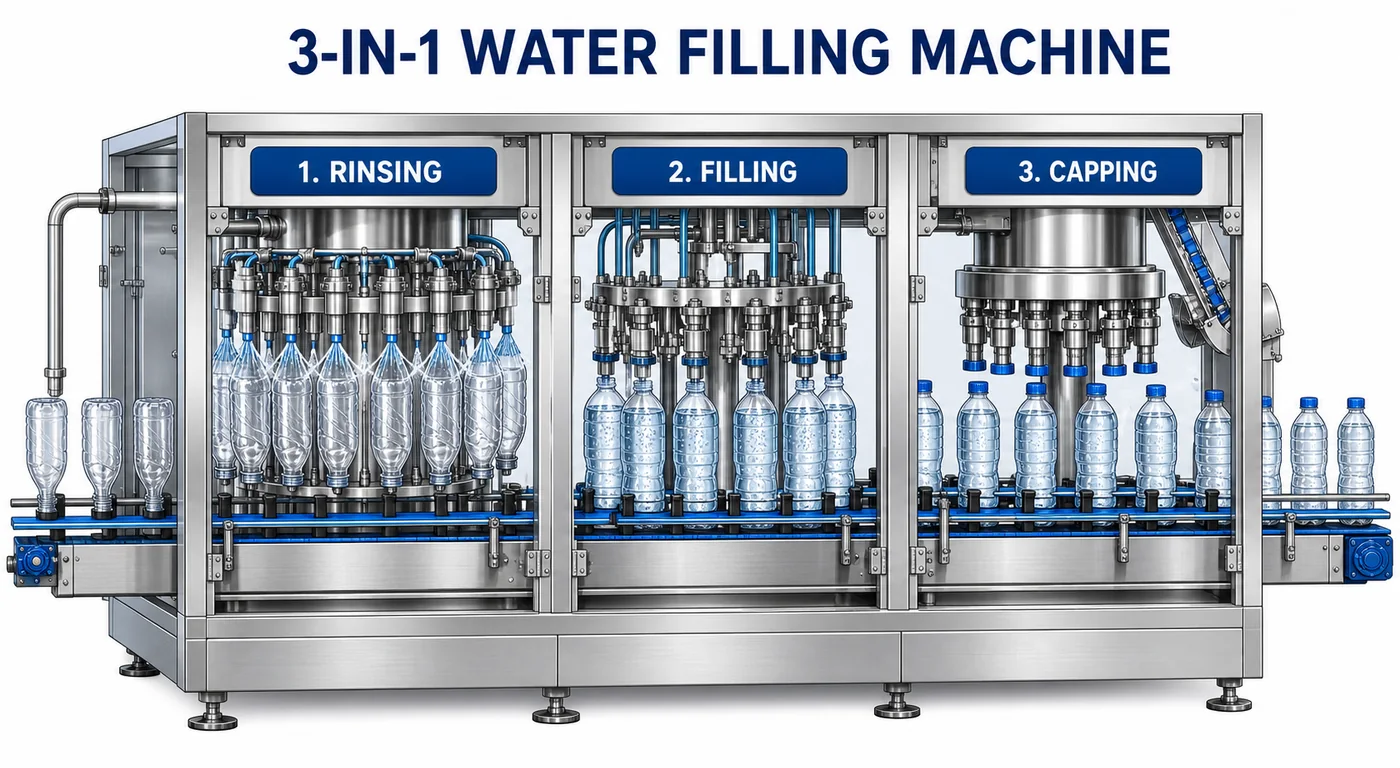
A 3-in-1 water filling machine integrates bottle rinsing, water filling, and capping on one synchronized platform. This configuration reduces transfers between separate machines, saves floor space, and supports cleaner production.
Bottle rinsing
The rinser should grip bottles securely by the neck, invert them smoothly, provide adequate rinsing time, and drain them before filling. Confirm nozzle design, rinse-water pressure, and compatibility with lightweight PET bottles.
Water filling
Stable filling is more important than peak speed. Check filling-level consistency, product-contact materials, valve design, and how the system responds to missing or damaged bottles. Uneven levels reduce shelf appearance and may create product giveaway.
Capping
A reliable cap sorter and feeder should deliver caps without frequent jams. Confirm capping torque, damaged-cap detection, and the machine’s response when bottles or caps are missing. Poor capping can result in leakage, contamination, and customer complaints.
Check Water Treatment and Product Supply
The filler can only perform consistently when the supplied water meets the required quality, pressure, temperature, and flow. Water treatment may include raw-water storage, filtration, activated carbon, reverse osmosis, UV sterilization, ozone, and finished-water storage, depending on the source and target standard.
The treatment system must provide enough water for filling, rinsing, cleaning, and peak demand. Undersized tanks, pumps, or pipes can starve the filler even when the machine itself is correctly selected. Final treatment design should be based on a water analysis and local regulatory requirements.
Review Utilities and Factory Conditions
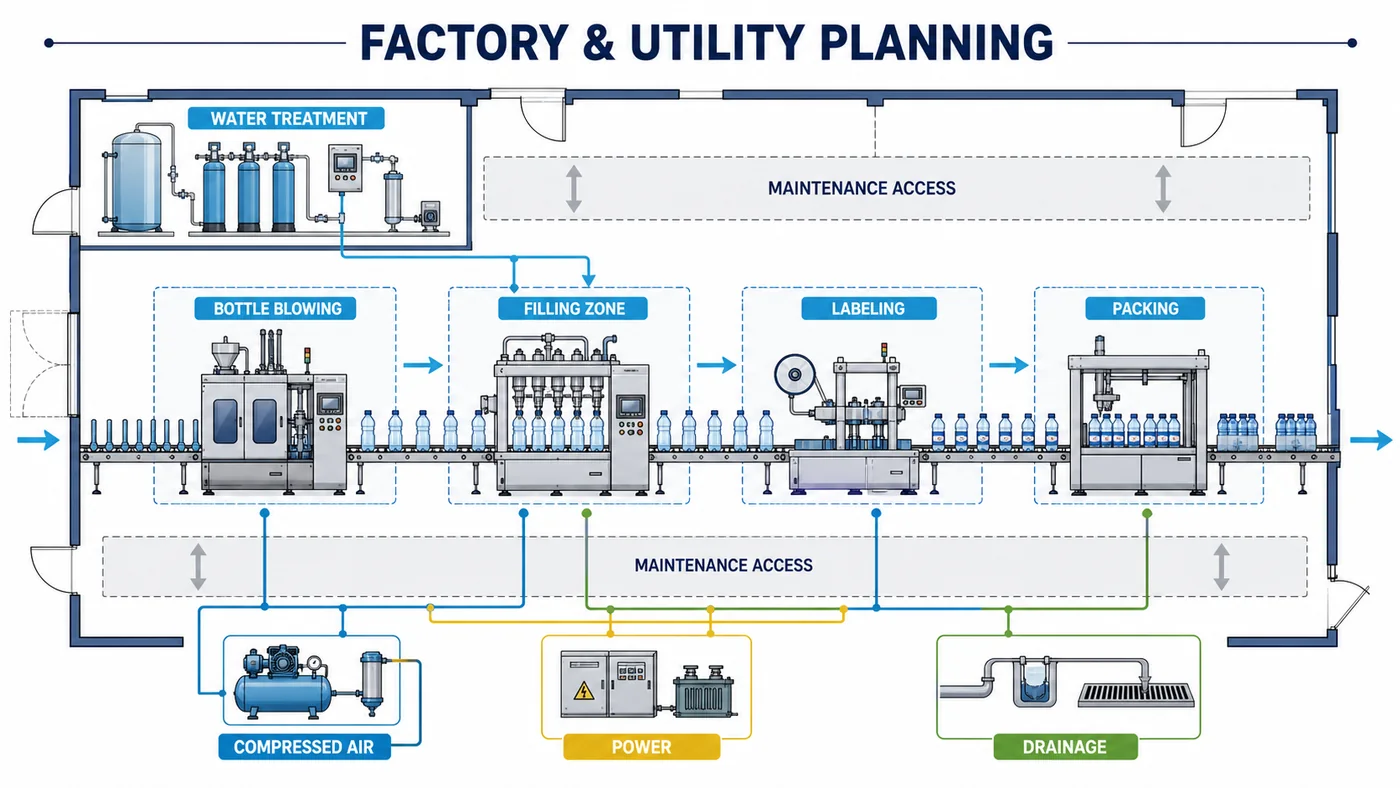
Before ordering, confirm available electricity, compressed air, process water, drainage, ventilation, ceiling height, access doors, and floor loading. Prepare a layout showing the treatment room, blowing area, filling zone, labeling and packing area, finished-goods flow, operator passages, and maintenance clearances.
Also confirm voltage, frequency, and phase. If the line includes bottle blowing, compressed-air quality and capacity can become a critical constraint. The equipment layout should allow safe operation and enough room to replace wear parts and service motors, pumps, valves, and conveyors.
Plan for Hygiene, Cleaning, and Food-Grade Construction
Bottled water is consumed directly, so hygienic design is essential. Product-contact tanks, pipes, and filling valves should use suitable food-grade stainless steel, commonly SUS304, with upgrades available where the process requires them.
Inspect weld quality, surface finish, drainage, access for cleaning, and potential dead zones. Ask how the machine is cleaned, which parts require manual disassembly, and whether cleaning procedures can be documented for operators. Good hygiene depends on equipment design plus disciplined factory practices.
Compare Suppliers by Lifecycle Value
Purchase price is only one part of the investment. Compare suppliers using a common technical checklist that covers guaranteed output, included equipment, component brands, installation, commissioning, training, spare parts, documentation, warranty, and remote support.
A lower initial quotation may exclude conveyors, change parts, utility equipment, installation, or packaging modules. Clarify the complete scope and calculate total ownership cost. Thank Pack provides A-to-Z beverage packaging solutions and a two-year warranty for its bottled water filling equipment, subject to the agreed project scope.
For additional technical background, see the complete guide to water filling machine technology and applications.
Prepare a Factory Acceptance Test
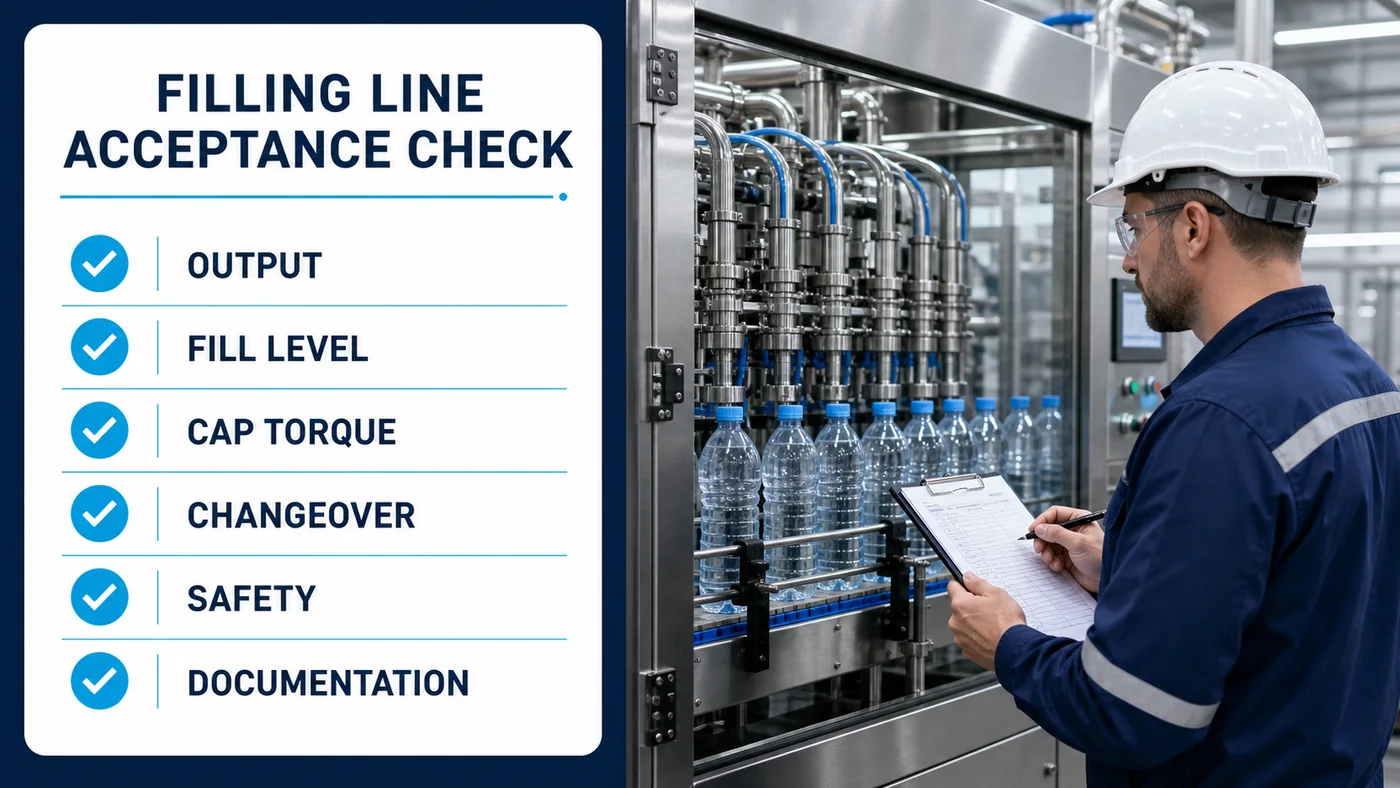
A factory acceptance test should use the agreed bottle and cap whenever possible. Define the test duration, target speed, acceptable fill-level variation, cap quality, reject rate, changeover procedure, alarm response, and required documentation before production begins.
Do not evaluate only whether the machine can run briefly at maximum speed. A meaningful test checks stable continuous operation, product quality, operator usability, safety functions, and recovery from normal production interruptions.
Allow for Future Expansion
Choose a line that supports realistic growth without paying too early for unused capacity. Expansion planning may include extra conveyor space, modular labeling or packing equipment, sufficient electrical load, larger water-treatment capacity, and a factory layout that allows new machines to be added later.
If a new project expects fast market growth, a modest capacity reserve can be useful. The reserve should be based on sales planning and cash flow, not on the largest machine available.
Final Selection Checklist
- Define daily saleable output and working hours.
- Calculate capacity using realistic line efficiency.
- Confirm output for every bottle size.
- Balance blowing, filling, labeling, and packing speeds.
- Verify water treatment and all utility requirements.
- Review hygienic design and cleaning procedures.
- Compare complete scope, service, warranty, and spare parts.
- Agree on factory acceptance criteria before shipment.
- Reserve practical space and utilities for future growth.
Conclusion
The right bottled water filling machine is the one that produces your required saleable output consistently, fits your bottles and factory, integrates with the complete line, and leaves sensible room for growth. Start with a documented production requirement, then compare solutions using verified bottle-specific capacity and total lifecycle value.
To receive a suitable machine recommendation, send Thank Pack your bottle sizes, cap samples, required BPH, working hours, water analysis, factory layout, and preferred packaging method. Contact Thank Pack at [email protected] or +86 151 6868 8886.
Frequently Asked Questions
1. What size bottled water filling machine do I need?
Divide your daily bottle target by available production hours and expected line efficiency. Then verify the result for each bottle size and select a machine with a reasonable operating margin.
2. Why is actual output lower than rated BPH?
Actual output is reduced by bottle size, cleaning, changeovers, label and cap replenishment, minor stops, inspections, and downstream bottlenecks. Ask suppliers to state the test conditions behind the rated speed.
3. Is a 3-in-1 water filling machine suitable for PET bottles?
Yes. A 3-in-1 monoblock is commonly used for 200 ml to 2 L PET bottled water because it integrates rinsing, filling, and capping in a compact, synchronized system.
4. Should I buy only the filler or a complete water bottling line?
Buy only the filler when compatible upstream and downstream equipment already exists. For a new factory, planning the complete line together reduces capacity mismatches and integration risk.
5. What information should I send before requesting a quotation?
Provide water type and analysis, bottle drawings or samples, cap details, bottle sizes, hourly and daily targets, working shifts, label and pack formats, utility conditions, factory layout, destination, and required standards.